Make an enquiry
Different Snow

THE PROBLEM WITH NOZAWA ONSEN

This is one of our favourite places to ski in Japan. However, it is becoming increasingly difficult for us to operate in Nozawa Onsen and, perhaps, we really need to start looking at alternatives...

THE PROBLEM WITH NOZAWA ONSEN

Let me start with a straight admission: I love Nozawa Onsen. Totally and unconditionally.

Not in a casual “oh yes, lovely place” sort of way either. I genuinely feel attached to it. I first visited sometime around 1995 or 1996 when I was living in Tokyo and disappearing most winter weekends into the Nagano Alps with my ski buddies. We skied everywhere — Gala Yuzawa, Hakuba Valley, Shiga Kogen — but Nozawa Onsen was always my favourite.

It was charming, characterful and unapologetically Japanese. At the time it felt like a secret I had somehow stumbled upon. I was usually the only foreigner in the village. And since then, I’ve always felt slightly protective of it. Irrationally so, perhaps. In my head, Nozawa Onsen is my resort.

And I still love it. Deeply. Which is precisely why, professionally, it now gives me sleepless nights. What was once straightforward has become — for a company specialising in luxury ski holidays to Japan — one of our biggest problems. I genuinely wish that weren’t the case. Let me explain....

Why Nozawa Onsen is so special?

Before getting into the problem, it’s important to explain why Nozawa matters so much.

A huge part of the Different Snow story is tied up in this village. We were among the first companies in the UK / European / North American market to really feature the resort properly and, to this day, we remain genuine specialists, with local contacts and relationships built over decades.

Off the mountain, Nozawa Onsen ticks every Japanese box imaginable. The village is absurdly pretty — all narrow lanes, wooden ryokans, steaming public onsens and little family-run restaurants hidden behind noren curtains. It remains authentic in a way many resorts no longer are, and crucially, much of it is still community owned. It still genuinely feels like a real place where people actually live, rather than a ski resort constructed purely for visitors.

The ski mountain itself is also excellent. Smaller than regional heavyweights like the huge peaks in the Hakuba Valley or neighbouring Shiga Highlands (‘Kogen’), certainly, but beautifully put together. Get yourself up into the Yamabiko area at the top of the mountain on a good snow day and you’ll understand the obsession immediately: perfectly spaced trees, deep snow, rolling terrain, fantastic views and some genuinely superb skiing. There are steeps, ungroomed blacks and enough playful terrain to keep strong skiers very happy for several days.

And then there are the mountain restaurants — gloriously unfussy little places serving bowls of ramen that are, without exaggeration, some of the best ski-slope food anywhere in Japan. Therefore, probably the world.

A potted history

The problem is the same one affecting much of Japan’s ski industry: overseas demand now massively exceeds supply. And the way Nozawa Onsen is responding to that demand is becoming increasingly difficult. A little history helps explain why...

Skis first appeared in Nozawa Onsen in 1912, with the village recording its first ski jump in 1922. In 1930, the Austrian ski pioneer Hans Schneider visited the village and introduced alpine skiing techniques.

Then came Japan’s great domestic ski boom of the 1960s and 70s, when young Tokyoites or Osakans piled onto overnight buses and headed for the mountains every weekend. Nozawa was one of the places to be.

That boom eventually collapsed alongside Japan’s bubble economy in the early 1990s and Nozawa Onsen, like many Japanese ski resorts, went in to decline for a decade or more, due to declining visitor numbers. As it happens it is during this period that I started visiting, living as a reasonably well-paid English teacher in the big city - I was filling my boots (with powder) during these doldrum years, having the time of my life!

By 2005 there were even discussions about merging the village administratively with nearby Iiyama City, because things were at such a low ebb. But it was around this point that overseas skiers first started discovering Japan and inbound tourism began to save the resort. A group of local accommodation owners started promoting Nozawa internationally and overseas visitor numbers exploded over the following decade, despite events like the 2009 financial crisis and the 2011 earthquake.

And explode is the right word. Australians in particular discovered Nozawa Onsen, followed by visitors from Hong Kong, Singapore, Korea, China and elsewhere in Asia. They fell in love with exactly the same things I had decades earlier: the authenticity, the atmosphere and the fact that it still felt genuinely Japanese.

What surprised me most, however, was what didn’t happen. For years I drove up from Iiyama each winter fully expecting to find the village transformed beyond recognition — flattened by foreign investment, stripped of character, overdeveloped and sanitised. And somehow… it never happened. Yes, there are more bars now. Better restaurants. Smarter accommodation. But remarkably little of the village’s soul has been lost. Nozawa Onsen today remains recognisably the same place it was 10 or even 20 years ago. The locals are still there. The public onsens still sit at the centre of daily life. Hot spring water still runs down the sides of the slightly ramshackle streets. Tiny family-run izakayas still serve brilliant local food. It has changed, certainly. But mostly for the better.

So… what’s the problem?

It’s pretty obvious, really. Demand has been climbing hard — year after year, season after season — and aside from the two global-apocalypse ski seasons when Japan slammed its borders shut, that trend hasn’t slowed down for a second.

Meanwhile, the supply of beds simply can’t keep up. Especially in a tightly controlled, chocolate-box village like Nozawa Onsen, where new development is heavily restricted — thank God for that, frankly — and hotel owners are left with only one option: buy existing properties, renovate them, and drag them into the modern era.

The catch? When you turn what used to be a cheap-and-cheerful pension into a slick luxury lodge, capacity drops. Every time. Luxury means space. Bigger rooms. Private en suites. Oversized king beds. Lovely for guests, terrible for bed numbers.

So demand keeps rising while supply stays flat — or, in many cases, actually shrinks. And once that happens, the outcome is inevitable.

You know the old line: book early to avoid disappointment? In Nozawa Onsen, that’s no longer friendly advice. It’s survival strategy.

Last season told the whole story. If you were organised enough to plan and book between March and May for the following winter, we still had a semi-decent shot at getting what you wanted. Leave it until June through August and we could usually sometimes still cobble something together with a bit of digging, a few favours, though all against a backdrop of mild desperation. But from September onwards? Different game entirely. At that point, booking a ski holiday that includes Nozawa Onsen becomes less ‘travel planning’ and more ‘forensic investigation into potential cancellations’. We’ll absolutely try — but realistically, we’re hunting for scraps falling off the table.

And yes, it really is that brutal.

And then the other problem: minimum stays

When we first started operating in Nozawa Onsen, some hotels only accepted bookings by fax. Confirmation often involved local partners physically driving around the village on scooters delivering envelopes full of cash. Professionally, it was chaos. Charming chaos, admittedly, but chaos nonetheless.

Thankfully those days are mostly gone. The internet has, eventually, arrived. Unfortunately, a different problem has replaced it: minimum stay restrictions.

For us, the ideal Nozawa Onsen stay is probably three or four nights. It works perfectly as part of a broader Japan itinerary — perhaps combined with other ski resorts on Honshu or even Hokkaido, or with Tokyo, Kyoto, Kanazawa or Takayama. In fact, Nozawa’s contrast with somewhere like Niseko is precisely what makes it so compelling. Niseko delivers scale and international energy; Nozawa delivers atmosphere, heritage and traditional Japan. For years this worked brilliantly. A few nights in Nozawa often became the highlight of an entire ski trip.

But hotel owners — particularly newer foreign owners — increasingly decided they were leaving money on the table. Their core markets, especially Australia and parts of Asia, tend to travel on a traditional one-week ski holiday model. So gradually, minimum stays began creeping upwards.

First three nights. Then four. Now, five-night minimums are becoming almost universal across the entirety of the ski season. And worryingly, we are already seeing seven-night minimum stays appearing for the 2027 season. For us, this creates a genuine logistical problem.

Seven nights in Nozawa Onsen is simply too long for most of our clients. I can absolutely justify five nights, even for the keenest and most expert of skiers, particularly if you add a guided day trip to nearby Madarao / Tangram, which has some of the best tree skiing in Japan.

But seven? No. The village is too small. The ski area, while excellent, is not expansive enough. And the opportunity cost becomes enormous. Spending a full week in Nozawa means not skiing Hokkaido or another resort on Honshu, not exploring Kanazawa, not seeing Sapporo, Kyoto or Tokyo, and not experiencing the incredible variety Japan does so well. And that, frankly, feels like a waste.

Nozawa Onsen is a brilliant short-stay resort. In many ways, it is the perfect short-stay ski resort. But current booking policies are making that increasingly difficult.

The balance of power has shifted

The other consequence of overwhelming demand is that accommodation owners now hold all the cards. What was once relaxed and informal has become rigid and aggressively business-like. Temporary room holds have virtually disappeared. Deposits of 40% — or even full payment upfront — are increasingly common. Cancellation policies are often brutally strict. It’s a far cry from the old days of fax machines and cash envelopes.

Of course, from the hotels’ perspective, this all makes perfect commercial sense. Rooms sell instantly and demand remains extraordinary. But for companies like ours — creating bespoke, multi-centre luxury itineraries — it has become increasingly difficult to make Nozawa work smoothly.

Which is frustrating, because we still desperately want to send people there. We know clients have heard about it. We know they want to experience it. And usually, they absolutely should. But when booking systems only permit five- or seven-night blocks during already oversubscribed periods, the whole process becomes enormously restrictive.

It’s a shame. A very real shame.

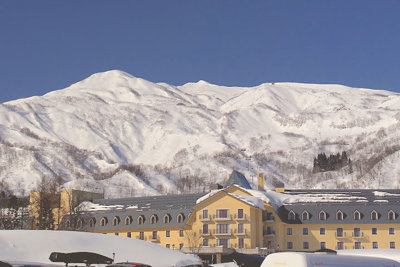
Akakura Onsen village in Myoko Kogen

So where does that leave us?

The fact is - Japan still has extraordinary ski regions still waiting to be discovered by our guests. Therefore, there are alternatives to Nozawa Onsen hiding in plain sight.

Myoko Kogen, for example, delivers a remarkably similar atmosphere in many respects and sits only a short distance away. Take a look at my blog ‘Our Love for Myoko Kogen’ to find out more about this outstanding resort.

Then there’s the Tohoku region in northern Honshu — an area we’re getting increasingly excited about. Hugely underrated, reliably buried in snow, and still blissfully under the radar internationally.

Take Zao Onsen, for example: an uncompromisingly Japanese ski resort with a seriously impressive mountain — substantially bigger than Nozawa’s — plus the added bonus of the famous “snow monsters” (which, to be clear, are ice-covered trees and not the result of too much saké).

Honestly, we should be sending far more guests to Zao Onsen, because it’s the closest thing I’ve seen to Nozawa Onsen circa 1996. The same authentic atmosphere, the same old-school Japanese ski culture, and the same feeling that you’ve stumbled across somewhere special before the rest of the world catches on. The accommodation scene is improving quickly, too. In fact, some of the best ryokans I’ve ever stayed in at a ski resort are tucked away in Zao village. And crucially, this is still where Japanese skiers go to ski — having been steadily priced out of Nozawa Onsen, or defeated by the increasingly brutal minimum-stay requirements.

Skking amongst the 'snow monsters' in Zao Onsen

In conclusion

Despite all of this, I will always love Nozawa Onsen. Because it is wonderful. Because our clients consistently adore it. And because, in some strange way, it feels personal to me.

Just understand that it’s no longer the easy little secret it once was. Demand now vastly outweighs supply, and accommodation owners are responding accordingly. So if we do manage to secure you a room in Nozawa Onsen during peak season, my advice is very simple:

Book it quickly. And thank your lucky stars.

Our customers rate us 'Excellent'

4.9 / 5

I cannot recommend them highly enough

Once in a lifetime trip to Japan and they where fantastic. The itinerary was the most detailed itinerary i have ever seen, they even included things that they had found while living in japan that would not be in the tourist guide books. They kept in contact with me every step of the way. I will definitely use them again.

Nicola  ·  Scotland

Highly recommend

We had no idea what to expect in Japan (or how we would get around), we couldn't have done it without the expertise and guide documents from Different Snow. Everything on the holiday ran very smoothly and we felt like we could call at any time if we had any questions.

Grace  ·  U.S.A.

Every detail was taken care of

We love to travel and I love planning trips, but Japan was just a little bit out of my comfort zone. I appreciated Nick’s expertise and was willing to pay for it! It was worth every penny in my mind. We appreciated the “guides” and all the suggestions.

Meg  ·  London

Please visit our Trustpilot page to read the full reviews.

Begin your journey
How to book

It's pretty straight forward. You simply need to take the first step by getting in contact with us...

Contact

Give us a call, or fill in the enquiry form, or send us an email. We’ll listen, give advice and make suggestions.

Itinerary

We create a tailor-made itinerary proposal and email this to you. Together, we then refine it until it is just as you want.

Deposit

A 20% deposit secures the booking. The balance payment is not due until 10 weeks before departure.

Travel Pack

We post out your comprehensive travel pack, which also includes all our local contacts and our invaluable ‘How To…’ guides.

Ask a quick question

Email address
Name
Your Question

Secure and Encrypted

By clicking this button I agree with the collection and processing of my personal data as described in the Privacy policy.

This site is protected by reCAPTCHA and the Google Privacy Policy and Terms of Service apply.