Different Snow
Hokkaido Island versus Honshu Island?
We appraise the merits of each of Japan's two ski islands...and then come to no firm conclusions as to which is best. That's because there are no wrong answers here, though we are prepared to offer a few personal opinions....
Should I ski on Hokkaido Island or stay on Honshu Island?
This is not a question with an easy answer - though many of the uninitiated seem to think the answer is emphatically “Hokkaido”. I can only presume - and actually, I know this is true - that the Hokkaido tourist authorities are simply better at promoting their ski mountains than those on Honshu. But it really isn’t that straightforward.
For us, though, the answer is actually quite simple: you should ski on both islands. And yes, it is perfectly possible to do so within a two-week holiday.
Let’s start at the beginning...
Japan has over 500 ski resorts (yes, you read that correctly). However, the ski mountains vary enormously in size - from large resorts with dozens of runs and endless off-piste/backcountry terrain easily accessed from the lifts, to tiny single-chair slopes barely worthy of the name. Truth be told, many of them are minuscule and, quite rightly, fly under the radar of international skiers.
Personally, I’ve skied more than 35 different resorts throughout Japan, across both islands, and have selected a fluid 10–14 of the very best to feature with Different Snow. This is a far broader portfolio than most tour operators, many of whom misguidedly believe that skiing on Hokkaido means “Niseko only”, and skiing on Honshu means “Hakuba only”. Great ski resorts both - but you’re short-changing yourself if you think that’s all Japan has to offer.
Many guests assume that Japanese skiing begins and ends on the northern island of Hokkaido. After all, this is home to Niseko — the resort that dominates Instagram feeds, ski films and YouTube edits alike. Surely this must be where the deepest and best powder snow in Japan is found?
Well…not exactly. The uncomfortable truth is that no two Japanese winters behave the same way. One season, Honshu can be buried beneath glorious and bountiful storms while Hokkaido sits beneath blue skies waiting for its next cycle. The following year, the pattern reverses entirely. Over the years, I’ve noticed one almost infuriating trend: if the snow quality was extraordinary in one particular region during a certain week one season, chances are high that the following year those exact same dates will favour somewhere completely different.
Such is the eternal frustration - and beauty - of skiing. We are all, ultimately, at the mercy of the ski gods, and they rarely like making life predictable.
Still, where possible, let’s try to be empirical about it.
Powder Coverage - The Truth
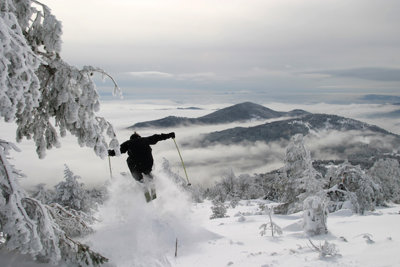
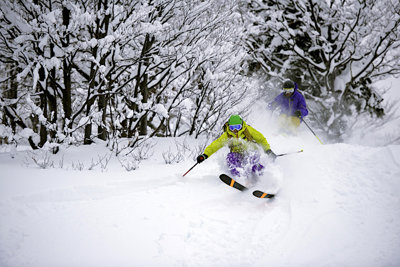
Most ski resorts across Japan receive an astonishing 12 to 18 metres of snow each season, regardless of whether you are on Honshu or Hokkaido. It falls with exuberant abundance wherever you are. The weather systems that move across the Sea of Japan from Siberia routinely dump this colossal volume of snow every winter without fail. It’s an east-to-west weather phenomenon, not north-to-south. Proximity to the west coast is the key factor, which means many ski resorts on Honshu deliver in spades - every bit as much as Hokkaido. And in addition to the sheer quantity, the snow quality is exceptional too: cold, dry and featherlight – the kind of snow that billows weightlessly through the trees and hangs in the air behind every turn.
The simple fact is this: Japan will probably be the best powder skiing experience of your life, whichever island you choose. We ski on both islands most seasons and rarely notice much difference. There is simply lots of snow everywhere.
Now, let’s back this bold assertion up with some statistics. Hokkaido does, statistically speaking, receive more snowfall overall — but only just. The main Honshu ski resorts average around 11 to 13 metres annually, which is roughly the same as Furano in central Hokkaido, and not far behind Niseko and Rusutsu at 14 to 15 metres.
However, there are some notable exceptions. Arai on Honshu receives roughly 16 metres annually, while nearby Myoko Kogen averages around 15 metres. Then there’s Hakkoda — a freeride mountain in northern Honshu — which gets so much snow that nobody seems entirely sure how to measure it properly. Across the Tohoku region in northern Honshu, many resorts routinely record 15 metres or more every season, much of it falling onto steep, sidecountry terrain that is properly deep and wild.
So what about snow quality? Because temperatures are marginally lower in Hokkaido, the powder is arguably a little drier, and the snowpack generally lasts longer into the late season. That’s the message the Hokkaido marketing teams put out there — and, to be fair, there is some truth in it.
Hokkaido
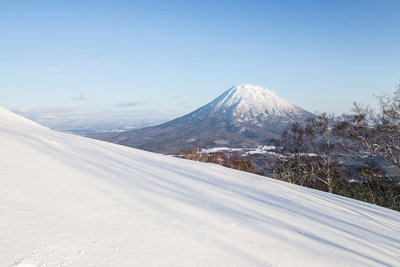
Hokkaido is volcanic, rural and remote. Towns are smaller, while farmland and national parks dominate the landscape. In winter, a vast white blanket seems to swallow absolutely everything.
However, conversely to the backwater character of Hokkaido as a whole, this is where you’ll find Japan’s larger and more internationally famous ski resorts. These are generally not traditional ski villages, but purpose-built ski resorts with modern infrastructure, polished facilities, and lots of apartment-style accommodation.
Because of the volcanic topography, many of the ski slopes have a wonderfully consistent pitch - not too steep, not too shallow - and the terrain tends to flow beautifully without too many awkward surprises.
As most skiing is at relatively low altitude, tree skiing is the norm, though the lifts often rise above the treeline into wide-open alpine terrain too.
The resorts closest to the west coast - Niseko, Rusutsu and Kiroro - receive the biggest snowfall totals. Resorts further inland, such as Furano, Tomamu and Asahidake, receive slightly less snow overall, but it is often even drier due to the lower moisture content.
Most overseas skiers gravitate toward Hokkaido, with Niseko being far and away the biggest draw. Which means competition for fresh tracks can be fierce - particularly during peak season. The resorts in central Hokkaido are generally much quieter, and the mountains themselves are bigger, offering more vertical skiing.
One downside? Choosing Hokkaido usually requires an additional domestic flight up to Sapporo, followed by another transfer of a couple of hours to your resort.
Honshu
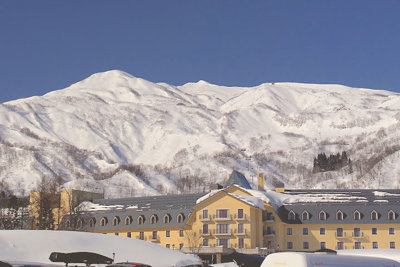
The majestic Japanese Alps form the backbone of Japan’s main island, and this is where you’ll find the majority of the country’s ski resorts.
The snow may not be quite as dry and fluffy as Hokkaido’s, but the terrain has noticeably more character. These are big mountains - proper 3,000-metre peaks more akin to the European Alps or the Rockies - which means open bowls, gullies, steeps, natural half-pipes and longer descents with significantly more vertical.
If you go looking for challenge, you’ll generally find more of it on Honshu. It is no accident that the Freeride World Tour stays on the main island. That’s not to say it’s all expert-only terrain - far from it - but if you like pushing yourself, this is where you do it, either within resort boundaries or out in the backcountry.
Once again, much of the skiing is at relatively low altitude, so both Hokkaido and Honshu offer exceptional tree skiing. Honshu, however, is usually a little less brutally cold during January and February, when Niseko can occasionally feel like skiing inside a chest freezer.
On the whole, Honshu’s ski resorts are older, more traditional, and carry more Japanese character. After all, this is where the Japanese themselves go skiing - the idea that everyone heads north to Hokkaido is largely a foreign invention.
The resorts are also within relatively easy reach of Tokyo and Kyoto, and the Nagano region in particular offers an enormous amount of cultural sightseeing: historic onsen towns, traditional Japanese architecture, temples, shrines and all manner of fascinating detours away from the slopes. This is also where you’ll find the famous snow monkeys - not in Hokkaido.
So where does this leave us?
Before I reveal which island I personally prefer (yes, I’m going to risk expressing an opinion), let me remind you that this does not have to be a binary choice.
Many guests - indeed, most guests - ski both islands within the same itinerary. Over a two-week trip, it is perfectly possible to spend five days skiing the volcanic slopes of Hokkaido, before heading south to the Japanese Alps on Honshu for another four or five days in the mountains… with enough time left over for sightseeing in Tokyo and perhaps Kyoto too.
This is, in many ways, the perfect Japan ski holiday. At least, that’s my opinion.
The answer? Well, my answer…
You’ve now made it all the way to the bottom of the blog, so the least I can do is reward you with my honest - though entirely personal - conclusion.
In my opinion, skiing and snowboarding on Honshu just about takes the prize. Especially for stronger skiers and snowboarders. Bigger mountains, better-spaced tree skiing, outstanding backcountry touring, and ski villages packed with Japanese character.
My friends and colleagues based in Hokkaido are going to be furious with me for saying this - and they’ll have every right to be. They will rightly point to the incredible snow quality, the sheer consistency of snowfall, and the internationally acclaimed ski resorts that Honshu arguably still can’t quite match in terms of sophistication. (Yes, Niseko, I’m looking at you.)
And there you have it. No easy answers. More importantly, no wrong answers.
We’ll listen carefully to what you want from a ski trip to Japan and match you with the right resort - or combination of resorts - accordingly. Importantly, we won’t simply assume you want Niseko or Hakuba (“hello” to many of our competitors), and we’ll tailor-make the entire adventure around your interests, ski ability, budget, timeframe and travel style.
But never assume you are somehow missing out if we suggest a resort on Honshu rather than Hokkaido. We are not - and never will be - in the business of selling second-rate experiences. It would make absolutely no sense for us to do so.
What we are about is creating the perfect tailor-made itinerary for you, without compromise.
The simple truth is that Japan has an embarrassment of riches when it comes to skiing. The real problem isn’t choosing between Hokkaido and Honshu.
It’s deciding where to start.